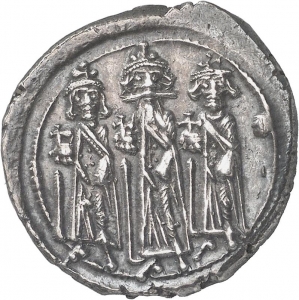
Byzanz: Heraclius I.638-641 |
|
|
Berlin, Münzkabinett der Staatlichen Museen |
Obverse |
Heraclius I. (Mitte) mit Heraclius Constantinus (r.) und Heraclonas (l.), alle drei mit Krone und Globus (sphaira) mit Kreuz in der r. Hand stehen nebeneinander in der Vorderansicht. |
Reverse |
dEUS AdIUtA ROMANIS [Deus Adiuta Romanis]. Kreuz auf Globus und dreistufiger Basis. |
Sitter |
Heraclius (610-641)
|
Class/status |
Imperial issue (medieval/modern) |
Authority |
Heraclius (610-641)
|
Date |
638-641 |
Denomination |
Hexagramm |
|
Silver |
Production |
struck |
Mint |
Constantinople |
Region |
Thrace |
Country |
Turkey |
Publications |
Ph. Grierson, Catalogue of the Byzantine coins in the Dumbarton Oaks Collection and in the Whittemore Collection II-1 (1968) Nr. 68 (datiert 638-641); D. R. Sear, Byzantine coins and their values ²(1987) 170 Nr. 803; W. Hahn, Moneta Imperii Byzantini III (1981) Nr. 146; B. Kluge, Numismatik des Mittelalters (2007) Nr. 1447 (dieses Stück). |
Item |
Coin |
Department |
Medieval Period, Early Middle Ages |
Accession |
1912/666 |
Vendor (to Museum) |
Dr. Jacob Hirsch (Munich)
|
Object number |
18204159 |
LIDO-XML |
|
JSON-IKMK |
|
JSON-LD |
|